
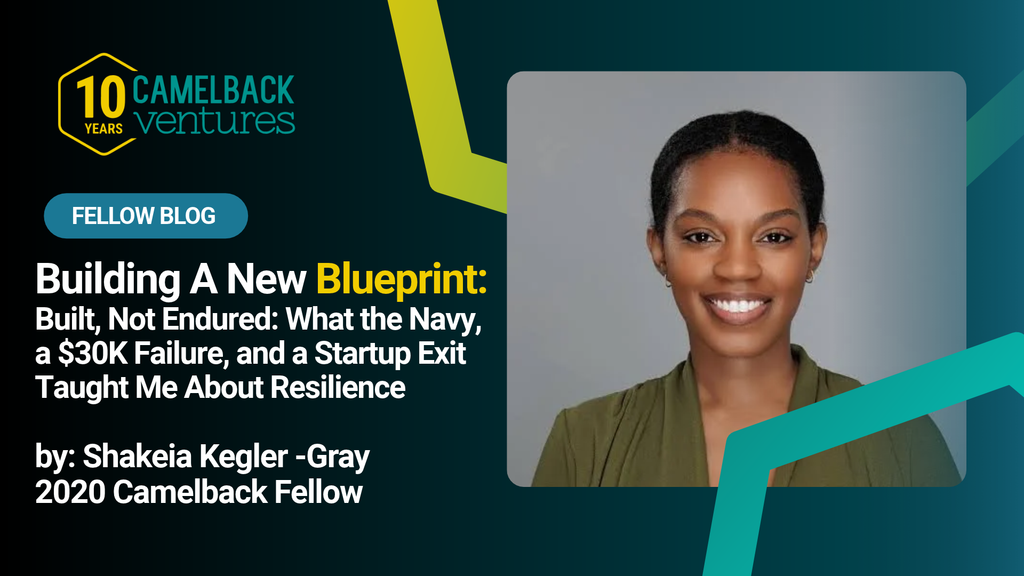
ShaKeia Kegler-Gray is a U.S. Navy veteran, 2020 Camelback Ventures Fellow, program manager at Black Ambition, and founder of ClearPath Solutions, which helps businesses navigate government contracting as a pathway to growth. She previously founded and sold GovLia, which helped businesses secure more than $100 million in contracts.
Let me be clear: resilience is not working yourself to the bone. It’s not pushing until you’re exhausted, with nothing left for yourself. That version isn’t strength. It’s unsustainable. Real resilience is built, not endured. It’s a set of systems that carry you so you don’t have to carry everything alone.
At 18, I was handed a $400,000 operating budget and reported directly to a Commander, the head of my weapons department. In the Navy, readiness isn’t a feeling. It’s something you train until it holds under pressure, so on your hardest day, the system holds you up.
That lesson carried me through eight years of service, 14 years in government contracting, building and selling a tech company, and now managing programs that support founders. This is my Resilience Bootcamp, built on five steps I call I SAVE: Inventory, Systemize, Assess, Validate, and Enlist. I built it with entrepreneurs of color and women in mind, because we’re too often asked to be resilient in a system that isn’t fair.
Lesson 1: Inventory— Name everything you’re carrying
In the Navy, the job you do on top of your actual job is called a collateral duty. My job was aviation ordnance, but I also served as repair parts petty officer, training petty officer, and quality assurance service officer. Those duties taught me budgeting, vendor management, and how to run something end to end. Just as important, the Navy named them. Every collateral duty had a title, so you could see the full load.
As a solo founder, I took on every role, but nobody gave those roles names. The Camelback Fellowship helped me change that. One assignment asked us to track how much time we spent on each task. Our work piles up quietly, and that’s where burnout starts. You can’t protect your energy from a load you’ve never measured. The Pareto principle says roughly 80% of your outcomes come from 20% of your efforts. Measuring is how you find that 20%, and how you see which tasks actually generate revenue. Purpose and profit have to stay aligned, because it takes money to serve our communities well.
Drill: For one week, list every task you do. Note whether it’s paid or unpaid, assigned or assumed, and whether it generates revenue. Then mark each one: only I can do this, this could be systemized, or this could go.
Lesson 2: Systemize: Stop being the system
The Navy doesn’t count on sailors to be brave on a bad day. It builds systems so bravery isn’t required. I saw this most clearly during an INSURV inspection on an aircraft carrier, the Navy’s top-to-bottom review of a ship’s material readiness. My role was purchasing: getting the right parts there in time to pass. That work earned me a flag letter of commendation, but we passed because of process, not heroics. Years later, my Lean Six Sigma Green Belt gave me language for it: cut the waste, standardize what works, and stop solving the same problem twice.
Today, as a program manager at Black Ambition, Pharrell Williams’ nonprofit supporting underrepresented founders, one of my goals is to never be the bottleneck. I build processes anyone on the team can follow, so the work keeps moving if I step away.
If your business only works when you’re at 100%, you don’t have a business yet. You have a sprint, and sprints end in exhaustion. The good news: a clear SOP can onboard a new hire, and today, the same documentation can train an AI agent to take work off your plate.
Drill: From the tasks you marked this could be systemized, pick the three that drain you most. Build a checklist, template, automation, or handoff for each. If you’ve done something more than twice, it deserves a system.
Lesson 3: Assess: Know when the mission changes
In the military, you learn not to confuse the mission with the unit. Missions end. Orders change. Founders don’t get orders, so we have to recognize the shift ourselves. Over eight years running GovLia, I reassessed the mission multiple times. I became the queen of the pivot because I let the data guide me, from customer interviews to our financials. In 2025, I made the biggest pivot of all: I sold GovLia. The mission I started with, getting more women-, minority-, and veteran-owned businesses into government contracting, didn’t end. It changed form.
A lot of exhaustion comes from fighting for a version of the mission that no longer fits. Assessing isn’t quitting. It’s checking whether your energy is still pointed at the right target, and whether you’re still serving the same customer. Look at your financials to see where you generate the most income, and your impact reports to see where you make the greatest difference. Drop what isn’t working and do more of what is.
Drill: Go deep, not wide. Write your mission in one sentence, without your company’s name. Name the customer behind your strongest revenue and deepest impact. Then ask of every task on your inventory: does this serve that mission and that customer? Repeat the check quarterly.
Lesson 4: Validate: Test before you build
Nothing burns founders out faster than pouring months into something nobody wants. I learned this the hard way. At GovLia, I ran more than 150 customer discovery interviews, then built our first platform based on what I heard. After $30,000 in development, the same customers we’d interviewed didn’t buy. Then the platform crashed during a pilot, which is a story for another day. We sunset it and went back to the drawing board.
The second time, before writing a line of code, I pitched government buyers using mock-up designs I created in Canva, and I closed contracts. We used that revenue to build the product with a qualified team, and that’s the solution I ultimately sold with GovLia.
Interviews tell you what people say. A sale tells you what they’ll do. If you can sell it before it’s ready, through a pre-order, deposit, letter of intent, or paid pilot, that will truly validate it, and you’ll fund the build instead of draining yourself to get there. That matters even more for founders with less access to capital. Companies with a Black founder or co-founder received just 0.32% of U.S. venture funding in 2025, according to Crunchbase.
Drill: Before adding anything new to your inventory, write it as a hypothesis: I believe [customer] will [pay for / use] [solution] because [reason]. Commit to a set number of conversations, and ask about the problem rather than your solution. Then try to sell it before it’s ready. If no one commits, that’s your answer.
Lesson 5: Enlist: Resilience shouldn’t be a solo sport
We ask founders of color and women to be endlessly resilient because the system around them often isn’t fair. Resilience shouldn’t be the price of admission, and carrying it all alone is one of the fastest roads to burnout.
The Navy never sent anyone into an inspection alone. Founders deserve the same chain of command, team, and plan. As a 2020 Camelback Fellow and a Goldman Sachs One Million Black Women alumna, I know what that support structure makes possible. I’ve also seen what one open door can do. During COVID, I connected Siemens Mobility with a small business that went on to win a $70,000 subcontract. That founder didn’t need more grit. They needed access.
Your community is one of your greatest resources, from introductions to feedback. Before you figure everything out alone, ask: who in my community specializes in this? And when you hire, tie every role to revenue. Purpose and profit move together.
Today I see this from the program side, supporting a portfolio of 157 alumni founders and more than 2,000 founders in our broader programming. What changes outcomes is access to decision-makers, honest feedback, and capital that arrives early enough to matter. Funders: if you want resilient founders, fund the systems, not just the success stories.
Drill: Challenge every task you marked only I can do this. For each one you can let go of, name someone in your community who can help, and send one ask this week.
Your Resilience Bootcamp
Burnout isn’t a badge of honor. It’s a signal that something in your system needs attention. Inventory what you carry. Systemize what drains you. Assess your mission and your customer. Validate before you build. Enlist your community.
Run I SAVE, and you save time, money, and energy. Most of all, you save yourself, so you can keep showing up for your business, your community, and the people you love without pouring from an empty cup.
Start this week: do your inventory, systemize one task, and send one ask. Resilience isn’t about never breaking. It’s about building something strong enough that you don’t have to carry it alone.
ShaKeia Kegler-Gray is a U.S. Navy veteran, 2020 Camelback Ventures Fellow, program manager at Black Ambition, and founder of ClearPath Solutions, which helps businesses navigate government contracting as a pathway to growth. She previously founded and sold GovLia, which helped businesses secure more than $100 million in contracts. You can connect with her at shakeiakegler.com, Linkedin, and Instagram.


